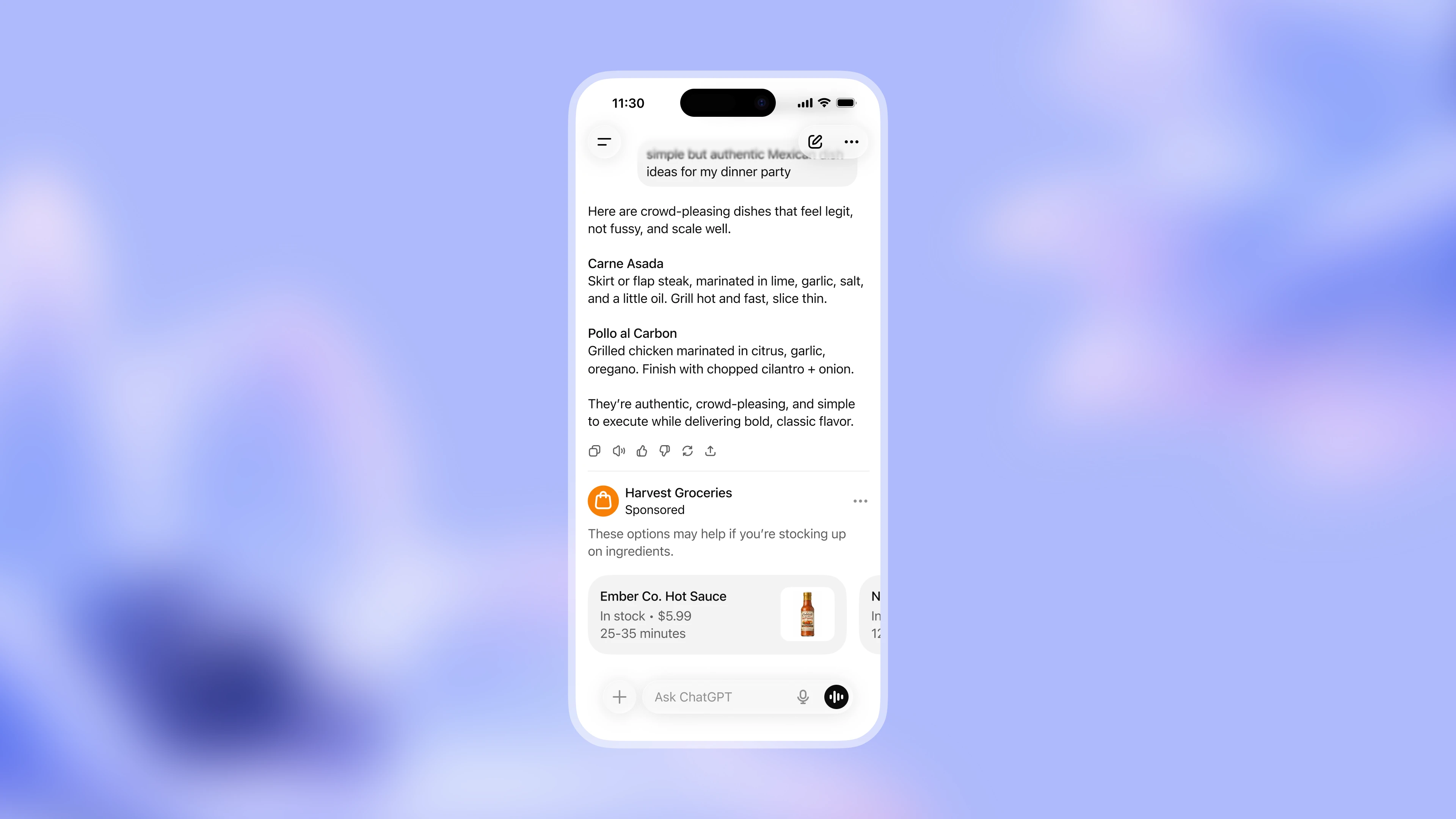
OpenAI has begun laying the groundwork for advertising inside ChatGPT, marking a meaningful shift in how conversational AI may be monetized. While ads are not yet available to brands, official documentation confirms that OpenAI will begin testing Ads for select users in the United States. In recent development following its announcement OpenAI plans to unveil its ChatGPT Ads format to dozens of advertisers in February.
For marketers and business leaders, this signals the early formation of a new advertising surface, one that sits closer to user intent than traditional display or social ads. Unlike search or social feeds, ChatGPT captures users in the act of asking, exploring, and deciding.
What Marketers Should Know
OpenAI is testing ads inside ChatGPT for users on the Free and ChatGPT Go plans in the US. Ads appear separately from AI-generated responses, are clearly labeled, and do not influence model outputs. Paid tiers such as Plus, Pro, Business, and Enterprise remain ad-free. Targeting is described as intent-based rather than profile-based, and OpenAI states that conversation data is not sold to advertisers. There is no public self-serve ad platform yet, but the foundations for conversational advertising are now visible. For example, if you’re eligible for the test, you’ll see clear in-product information when it begins.
How ChatGPT Ads Work Today
According to OpenAI’s documentation, ads are designed to appear below a ChatGPT response when a user’s query indicates commercial intent. Ads are visually distinct and separated from the assistant’s output, reinforcing that responses themselves are not sponsored.

ChatGPT is positioning ads as contextual recommendations rather than blended content, preserving the credibility of the assistant while introducing monetization at the end of the interaction. For example, if a user asks for “the best hiking trails in the Pacific Northwest,” the model provides its organic advice first. Following the answer, a sponsored module may appear featuring gear or local services.
At this stage, advertisers cannot directly launch campaigns. There is no dashboard, API, or auction model publicly available.
Who Sees Ads
OpenAI is segmenting its inventory to protect its premium subscribers while monetizing its higher-volume tiers. Currently, ads are strictly limited to adult users in the US on the following plans:
- Free Tier: The largest segment, serving as the primary inventory for high-reach campaigns.
- ChatGPT Go: The new $8 per month tier, where ads help subsidize the lower subscription cost.
Users on Plus, Pro, Business, and Enterprise plans remain fully ad-free.
Ads are also excluded from sensitive categories such as health, mental health, political content, and interactions involving minors. This mirrors the brand safety scaffolding used by large ad platforms, though applied to a conversational interface rather than a feed or results page.
Privacy, Targeting, and What’s Different from Search
The biggest differentiator for ChatGPT ads is the shift away from third-party cookies and deep user profiling. OpenAI claims it does not sell user data to advertisers. Instead, the targeting is contextual and intent-based.
In practice, for an ad to be truly “relevant,” the platform must still interpret and process the semantic depth of a user’s conversation. While the data may not be “sold,” it is certainly being utilized as the engine for the auction to decide when an ad is relevant.
Why This Matters for Advertisers
When a user is in a deep-dive conversation with an AI, they are in a state of active problem-solving. A well-placed ad in this context feels like the next logical step in the user’s journey. This opens the door to:
- Fewer impressions with potentially higher conversion
- Higher-intent exposure
What to Watch Next
Once OpenAI moves from internal tests to a broader pilot, expect to see the first public ad-buy opportunities emerge through direct-invite partnerships with major retailers. The next big milestone will be the launch of a dedicated “Ads API” or a self-serve platform that allows small and medium businesses to bid on conversational intent.
Join the Conversation
Are intent-based ads the “cleaner” future of digital marketing? Share your take in the comments, or continue the discussion with me on LinkedIn, X, or on Threads.



Leave a Reply